The five levels of learning designer support
Learning designers and academics may have different expectations when it comes to collaborating on course design. Here鈥檚 how a five-point scale can help
March 10, 2026

Learning designers and academics may have different expectations when it comes to collaborating on course design. Here鈥檚 how a five-point scale can help

Steady momentum and a clear narrative that links your work across research, teaching and leadership can help others see the direction and impact of your career, say Karen Lander and Joseph L. Brooks

How a design thinking approach can support agile, innovative new course development

What does accessibility mean in principle, and how does it actually look in practice? Find guidance here on engaging students in learning, dealing with sensory issues and how to be flexible with assessment

Reframing productivity and defending your diary can transform academic output. Here are tips for protecting your writing time

GenAI tools are getting better at tasks such as sorting data, writing basic reports and generating simple code. That鈥檚 why higher education needs to focus on what it can鈥檛 do

Students often develop valuable transferable skills during their studies but struggle to recognise and articulate them to employers. Here鈥檚 how academics can work with careers professionals to support

Securing success in global research initiatives demands shifting research integrity from a bureaucratic checklist to a cultural measure of trust and transparency

A technique to help universities improve collaboration, reduce inefficiencies and build shared understanding across teams to support more effective working 鈥� and a framework for successful implementation

Professors can gain immediate, practical benefits if they listen to early career researchers, through inter-generational exchanges such as reverse mentoring. Here, Ian Williams offers five capabilities that ECRs can offer more seasoned scholars

The foundation of widening participation lies in a curriculum that is flexible enough to accommodate increasing student diversity while aligning with industry needs, writes James Williams
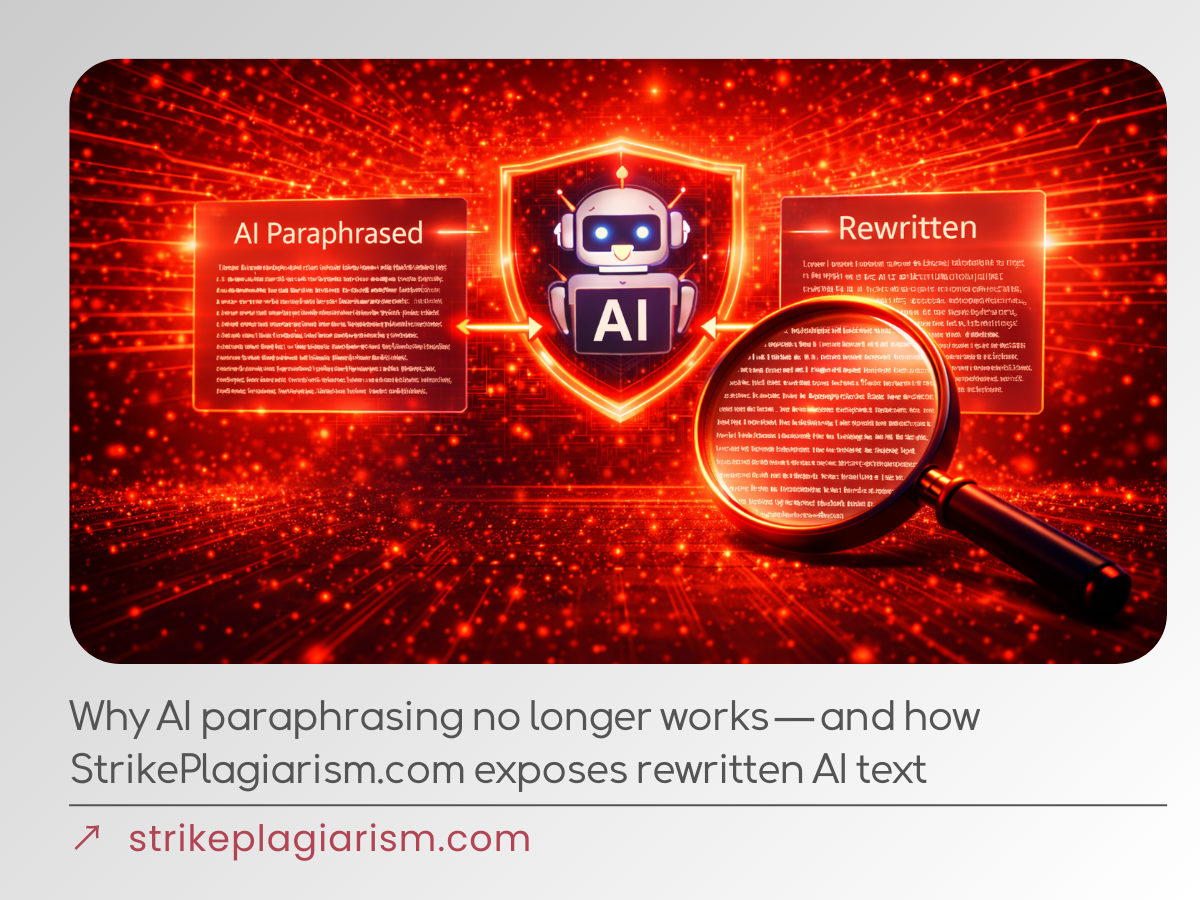
As generative AI becomes a routine tool in academic writing, a persistent belief continues to circulate: that AI-generated text can be made 鈥渟afe鈥� through paraphrasing or human rewriting. Change the wording, adjust the structure 鈥� and detection will fail.

In the digital age, trust in educational technology is built not only on analytical performance, but on the responsible handling of data. Universities and schools work with highly sensitive information: academic work, assessment materials, and personal data of students and staff. Protecting this information is fundamental to the credibility of academic processes.
StrikePlagiarism has launched a new integration between StrikePlagiarism.com and Microsoft Teams 鈥� one of the most widely used platforms for distance and hybrid learning in higher education. This step responds to a growing institutional challenge: maintaining academic integrity directly within the environments where teaching, learning, and assessment already take place.
StrikePlagiarism has launched a new integration between StrikePlagiarism.com and Google Classroom, extending academic integrity controls directly into one of the most widely used digital learning environments in higher and secondary education worldwide.